
Student: Kai Langer
Supervisors: Prof. Dr. Philip von Doetinchem, Prof. Dr. Claudio Kopper
University: University of Hawai’I at Manoa
Type: Research-Oriented Project
Term: SoSe 2025
Introduction
My name is Kai Langer and I have been enrolled in the research oriented study track since 2023 in Erlangen. From July to October 2025 I did a three months research internship on the geomagnetic cutoff and -efficiency for low-rigidity cosmic-ray measurements at the University of Hawai’I at Manoa in the working group of Philip von Doetinchem. (https://www.phys.hawaii.edu/%7Ephilipvd/pvd_home.html ) This project was supported by the RISE Worldwide (https://www.daad.de/rise/de/rise-weltweit/ ) program of the DAAD.
DAAD and RISE Worldwide
RISE Worldwide is a program of the DAAD to support undergraduate students in natural sciences in conducting research internships worldwide. For this cause professors around the globe can offer research opportunities and German undergraduate students can apply for up to three of those for a duration of six to twelve weeks. For the application process a letter of recommendation, your transcript of records and a motivational letter is needed. The program not only encompasses the internship position, but also a financial stipend, insurance and recommendation letters for a potential visa process. During my internship a J1 visa was needed for a stay at a US university. The visa process took 4 months and you can to apply to the RISE Worldwide program up to December 15th the year before your summer internship.
Living and working in Manoa, Hawai’i
Working and living in Manoa and Honolulu provides you with unique possibilities next to your internship. Honolulu, the capital of Hawai’i, where I was living, is located on the island of O’ahu and boasts with a wide variety of culture, beaches, mountains, international restaurants and other freetime activities. Personal highlights of me were many different theatres and plays, the Honolulu Museum of Art, the Bishop Museum on the history and culture of Hawai’i, incredible beaches like De-Russy and Waikiki and especially the many hiking trails all over the mountain ridges.
Results of my research project
Below I will provide you with a short summary of the most important results of my research. You can find a comprehensive report here (here add link to my report when it is finished). My work was built upon the previous research internship of Lukas Hennig, a fellow student of the FSG. You can find the text about his project here ( https://www.physics-advanced.de/2022/08/05/extension-of-the-planetocosmics-framework-for-the-calculation-of-geomagnetic-cutoff-histograms/).
After the extension of the PLANETOCOSMICS framework to accurately calculate the rigidity and forbiddenPathProbability, my first task was to produce maps of the rigidity-cutoff across the Earth for the full timeframe of AMS-02 data taking since May 2011 up to today. An example for those rigidity maps from 2024.11 can be found below:
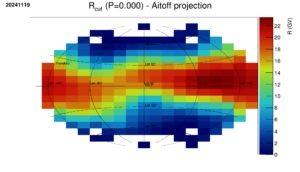
Subtext: The geomagnetic cutoff rigidity per position bin across earth on November 19th 2025.

Subtext: The averaged geomagnetic cutoff rigidity in the area covered by the ISS orbit on November 19th 2024.
Based on these results I sampled the ISS trajectory around Earth and calculated the geomagnetic efficiency. In simple words this is the percentage of measurement time during which the rigidity cutoff lies below a fixed rigidity thus making it possible for the detector to measure primary cosmic-rays which do not result from reactions in the Earth’s atmosphere. The research group of Philip von Deotinchem is especially interested in the measurement of low-rigidity cosmic-rays thus making it especially important to have a good knowledge of the geomagnetic efficiency and the specific geomagnetic rigidity cutoff for each measurement point and time. The normalized geomagnetic efficiency is the geomagnetic efficiency for a forbiddenPathProbability greater than 0 divided by the geomagnetic efficiency for forbiddenPathProbability 0. This can give us an insight in which rigidity range it may be fruitful to consider measured events with forbiddenPathProbability >0 which have a probability of being a primary cosmic-ray 1-forbiddenPathProbability. Histograms for the (normalized) geomagnetic efficiency for 2024.11 can be seen below:
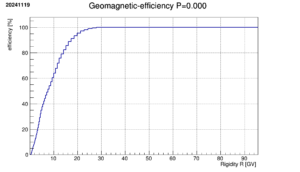
Subtext: The geomagnetic efficiency along the ISS trajectory on November 19th 2024.
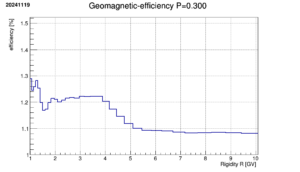
Subtext: The normalized geomagnetic efficiency between R=1-10GV along the ISS trajectory on November 19th 2024.
My final step of the research project was to analyse the temporal evolution of the (normalized) geomagnetic efficiency for the operational period of AMS-02. Here we do not only observe spikes in the geomagnetic efficiency during periods of increased solar activity but while analysing simulated data for a complete solar cycle of 11 years we also observe a gradual increase of the overall normalized geomagnetic efficiency. It will be the task of future analysis to find potential correlations of different magnetic field parameters and the geomagnetic efficiency. The temporal evolution of the (normalized) geomagnetic efficiency can be seen here:

Subtext: Temporal evolution of the geomagnetic efficiency for different forbiddenPathProbabilities.
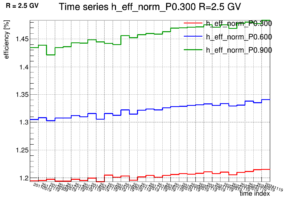
Subtext: Temporal evolution of the normalized geomagnetic efficiency for different forbiddenPathProbabilities.
During solar flare events the geomagnetic cutoff drops and multiple channels for low rigidity cosmic-rays open up to be measurable by our detector. That is why as an additional sub-task I repeated the geomagnetic efficiency analysis of a solar flare event during March 2012 of Philip from Doetinchem with the extended PLANETOCOSMICS framework and was able to not only underscore the results of the previous analysis but also find dependencies on different forbiddenPathProbabilities.
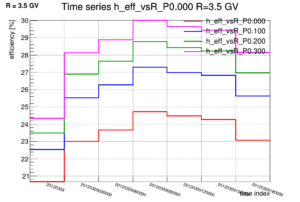
Subtext: Temporal evolution of the geomagnetic efficiency for different forbiddenPathProbabilities during the solar flare event.
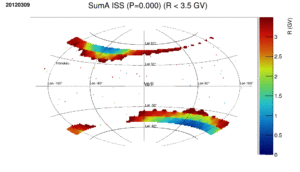
Subtext: Temporal evolution of the geomagnetic cutoff rigidity at the positions with R<3.5GV during the solar flare event.
To also have the possibility to apply the built analysis framework to calculate the specific geomagnetic rigidity cutoff and forbiddenPathProbability for a single measured event of AMS-02 with uncertainty in the measured incoming direction and rigidity I also implemented a single event analysis tool. While the functionality of the single event tool was tested, the accuracy still needs to be improved since our temporal grid spacing of six months is too coarse for potentially fast changes of the geomagnetic rigidity cutoff due to solar activity.
During the wrap-up of the project we found a dependency of the results on the chosen positional grid size used during the simulation. The deviation of the results using a coarse and fine position grid was most pronounced in the especially interesting low rigidity region. It will be a task for further research to find the optimal grid size and to fully interpret the results found during our simulations.
The project would not have been possible without the computing resources of the University of Hawai’i High Performance Cluster where more than 26 years of CPU time have been used for the needed simulations.